Ensemble Time series diagnostic
Description
The Ensemble Time series diagnostic provides tools to compute and visualize ensemble statistics of 1D time series data:
Compute ensemble mean and standard deviation for monthly and annual time series
Generate plots with ensemble mean and ±2 standard deviation envelope
Compare ensemble statistics with reference datasets (e.g., ERA5)
Classes
There is one class for the analysis and one for the plotting:
EnsembleTimeseries: computes ensemble mean and standard deviation for 1D time series data. It handles both monthly and annual data, computing statistics point-wise along the time axis. Results are saved as class attributes and as NetCDF files.
The standard deviation is computed point-wise along the time axis. A reference time series can also be added to the plot.
PlotEnsembleTimeseries: provides methods for plotting time series with ensemble mean and ±2 standard deviation envelope. It supports adding a reference time series for comparison.
File structure
The diagnostic is located in the
aqua/diagnostics/ensembledirectory, which contains both the source code and the command line interface (CLI) scripts.Template configuration files are available in the
aqua/diagnostics/templates/diagnostics/config-ensemble_timeseries.yamldirectory.Notebooks are available in the
notebooks/diagnostics/ensembledirectory and contain examples of how to use the diagnostic.
Input variables and datasets
Before using the diagnostic, input data must be loaded and merged using the Reader class via
aqua.diagnostics.ensemble.util.reader_retrieve_and_merge. The final merged dataset will contain all the requested ensemble members with appropriate metadata.
Alternatively, data can be provided as a list of NetCDF file paths and merged with merge_from_data_files.
The merged dataset must contain all ensemble members concatenated along a pseudo-dimension named ensemble (by default, but customizable).
A variable that is typically used in this diagnostic is:
2t(2 metre temperature)
Example: loading and merging a 1D monthly time series ensemble into an xarray.Dataset:
import glob
from aqua.diagnostics import merge_from_data_files

file_list = glob.glob(
    '/path/to/monthly/timeseries/*.nc'
)
file_list.sort()

ens_dataset = merge_from_data_files(
    variable='2t',
    model_names=['IFS-FESOM', 'IFS-NEMO'],
    data_path_list=file_list,
    log_level="WARNING",
    ens_dim="ensemble",
)
Example: loading via the AQUA Reader
from aqua.diagnostics import reader_retrieve_and_merge

ens_dataset = reader_retrieve_and_merge(
    variable='2t',
    catalog_list=['nextgems4', 'climatedt-phase1'],
    models_catalog_list=['IFS-FESOM', 'IFS-NEMO'],
    exps_catalog_list=['historical-1990', 'historical-1990'],
    sources_catalog_list=['aqua-atmglobalmean', 'aqua-atmglobalmean'],
    log_level="WARNING",
    ens_dim="ensemble",
)
Basic usage
The basic usage of this diagnostic is explained with a working example in the notebook.
The ensemble analysis is performed on merged 1D timeseries by EnsembleTimeseries class.
The basic structure is the following:
from aqua.diagnostics import EnsembleTimeseries, PlotEnsembleTimeseries

ts = EnsembleTimeseries(
    var='2t',
    model_list=['IFS-FESOM', 'IFS-NEMO'],
    monthly_data=mon_model_dataset,
    annual_data=ann_model_dataset,
    outputdir='./',
    loglevel='WARNING',
)

ts.run()

ts_plot = PlotEnsembleTimeseries(
    model_list=['IFS-FESOM', 'IFS-NEMO'],
    ref_model='ERA5',
    loglevel='WARNING',
)

ts_plot.plot(
    var='2t',
    monthly_data=ts.monthly_data,
    monthly_data_mean=ts.monthly_data_mean,
    monthly_data_std=ts.monthly_data_std,
    annual_data=ts.annual_data,
    annual_data_mean=ts.annual_data_mean,
    annual_data_std=ts.annual_data_std,
    ref_monthly_data=mon_ref_data,
    ref_annual_data=ann_ref_data,
)
Note
Start/end dates and reference dataset can be customized. If not specified otherwise, plots will be saved in PNG and PDF format in the current working directory.
CLI usage
The diagnostic can be run from the command line interface (CLI) by running the following command:
cd $AQUA/aqua/diagnostics/ensemble
python cli_multi_model_timeseries_ensemble.py --config <path_to_config_file>
Other CLI scripts available:
cli_single_model_timeseries_ensemble.py: for single-model ensemble timeseries analysis
Additionally, the CLI can be run with the following optional arguments:
--config,-c: Path to the configuration file.--nworkers,-n: Number of workers to use for parallel processing.--cluster: Cluster to use for parallel processing. By default a local cluster is used.--loglevel,-l: Logging level. Default isWARNING.--catalog: Catalog to use for the analysis. Can be defined in the config file.--model: Model to analyse. Can be defined in the config file.--exp: Experiment to analyse. Can be defined in the config file.--source: Source to analyse. Can be defined in the config file.--outputdir: Output directory for the plots.--startdate: Start date for the analysis.--enddate: End date for the analysis.
Configuration file structure
The configuration file is a YAML file that contains the details on the dataset to analyse or use as reference, the output directory and the diagnostic settings. Most of the settings are common to all the diagnostics (see Diagnostics configuration files). Here we describe only the specific settings for the Ensemble Time series diagnostic.
ensemble: a block (nested in thediagnosticsblock) containing options for the Ensemble Time series diagnostic. Variable-specific parameters override the defaults.run: enable/disable the diagnostic.diagnostic_name: name of the diagnostic.Ensemble Time seriesfor this diagnostic.variable: list of variables to analyse.region: region to analyse (e.g.,global).startdate_data/enddate_data: time range for the dataset.startdate_ref/enddate_ref: time range for the reference dataset.plot_ensemble_members: if True, plot individual ensemble members.
ensemble:
    run: true
    diagnostic_name: 'EnsembleTimeseries'
    variable: ['2t']
    region: ['global']
    params:
        default:
            startdate_data: "1990-01-16"
            enddate_data: "2014-11-16"
            startdate_ref: "1990-01-16"
            enddate_ref: "2014-11-16"
    plot_params:
        default:
            title: null
            plot_ensemble_members: True
Output
The diagnostic produces the following outputs:
Time series plots with ensemble mean and ±2 standard deviation envelope
Optional reference dataset comparison
Plots are saved in both PDF and PNG format. Data outputs are saved as NetCDF files.
Observations
The default reference dataset is ERA5 reanalysis, provided by ECMWF.
Custom reference datasets can be configured in the configuration file.
Example Plots
All plots can be reproduced using the notebooks in the notebooks directory on LUMI HPC.
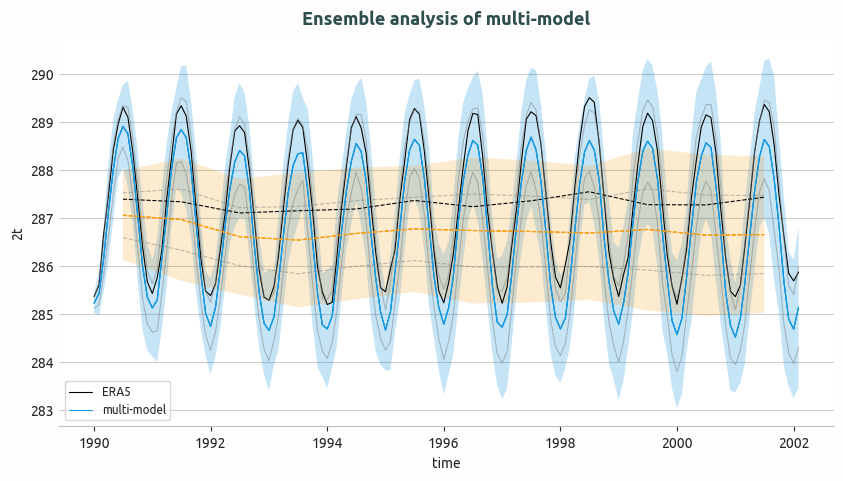
Ensemble of multi-model global monthly and annual timeseries and compared with ERA5 global monthly and annual average. Models considered as IFS-NEMO and IFS-FESOM.
Available demo notebooks
Notebooks are stored in the notebooks/diagnostics/ensemble directory and contain usage examples.
Detailed API
This section provides a detailed reference for the Application Programming Interface (API) of the Ensemble Time series diagnostic,
produced from the diagnostic function docstrings.
Note
WORK IN PROGRESS