Ocean Stratification Diagnostic
Description
The OceanStratification diagnostic is a set of tools for the analysis and visualization of ocean stratification and mixed layer depth (MLD) in climate model outputs. It supports comparative analysis between a target dataset (typically a climate model) and a reference, commonly an observational dataset such as EN4.
Ocean Stratification provides tools to:
Compute potential density from temperature and salinity fields
Calculate mixed layer depth (MLD)
Generate vertical stratification profiles averaged over specific basins
Produce climatological analyses (monthly, seasonal, yearly, or total period)
Classes
The diagnostic is designed with a class that analyzes ocean data and computes stratification metrics, and other two classes that produces the plots.
Stratification: retrieves ocean data (temperature, salinity) and computes derived quantities including potential density and mixed layer depth. It handles spatial averaging over specified regions, climatology computation, and unit conversions. Results are saved as class attributes and as NetCDF files.
PlotStratification: provides methods for plotting vertical stratification profiles of temperature, salinity, and density. It generates multi-panel plots comparing model and reference data across different variables.
PlotMLD: specialized class for plotting mixed layer depth maps and statistics. It generates spatial maps and comparative visualizations of MLD fields.
File structure
The diagnostic is located in the
aqua/diagnostics/ocean_stratificationdirectory, which contains both the source code and the command line interface (CLI) script.A template configuration file is available at
aqua/diagnostics/templates/diagnostics/config-stratification.yamlNotebooks are available in the
notebooks/diagnostics/ocean_stratificationdirectory and contain examples of how to use the diagnostic.Regions definitions are available in
aqua/diagnostics/config/tools/ocean3d/definitions/regions.yaml
Input variables and datasets
By default, the diagnostic compares against the EN4 dataset, but it can be configured to use any other dataset as a reference. The diagnostic requires 3D ocean data that includes vertical level information (depth or pressure).
The primary variables used in this diagnostic are:
thetao(sea water potential temperature)so(sea water salinity)
Derived variables computed by the diagnostic:
rho(potential density anomaly)mld(mixed layer depth)
The diagnostic is designed to work with data from the Low Resolution Archive (LRA), generated by the Data reduction OPerator (DROP) of the AQUA project, which provides monthly data at a 1x1 degree resolution. A higher resolution is not necessary for this diagnostic.
Basic usage
The basic usage of this diagnostic is explained with a working example in the notebook. The basic structure of the analysis is the following:
from aqua.diagnostics import Stratification, PlotStratification, PlotMLD

strat = Stratification(
    catalog='climatedt-phase1',
    model='IFS-NEMO',
    exp='historical-1990',
    source='lra-r100-monthly',
    startdate='01-01-1991',
    enddate='31-05-1992',
    loglevel='DEBUG'
)

strat.run(
    dim_mean=["lat","lon"],
    outputdir=".",
    var=['thetao', 'so'],
    region="ls",
    mld=False,
    climatology="January",
)

ps = PlotStratification(
    data=strat.data[['thetao', 'so', 'rho']],
    obs=strat.data[['thetao', 'so', 'rho']]*1.001,  # just to have different data for obs
    loglevel='DEBUG',
)
ps.plot_stratification()

ps = PlotMLD(
    data=strat.data[['mld']],
    obs=strat.data[['mld']]*1.1,
    loglevel='DEBUG',
)
ps.plot_mld()
CLI usage
The diagnostic can be run from the command line interface (CLI) by running the following command:
cd $AQUA/aqua/diagnostics/ocean_stratification
python cli_ocean_stratification.py --config <path_to_config_file>
Additionally, the CLI can be run with the following optional arguments:
--config,-c: Path to the configuration file.--nworkers,-n: Number of workers to use for parallel processing.--cluster: Cluster to use for parallel processing. By default a local cluster is used.--loglevel,-l: Logging level. Default isWARNING.--catalog: Catalog to use for the analysis. Can be defined in the config file.--model: Model to analyse. Can be defined in the config file.--exp: Experiment to analyse. Can be defined in the config file.--source: Source to analyse. Can be defined in the config file.--outputdir: Output directory for the plots.--startdate: Start date for the analysis.--enddate: End date for the analysis.
Configuration file structure
The configuration file is a YAML file that contains the details on the dataset to analyse or use as reference, the output directory and the diagnostic settings. Most of the settings are common to all the diagnostics (see Diagnostics configuration files). Here we describe only the specific settings for the ocean stratification diagnostic.
ocean_stratification: a block (nested in thediagnosticsblock) containing options for the Ocean Stratification diagnostic.stratification: sub-block containing specific parameters for stratification analysis.run: enable/disable the diagnostic.diagnostic_name: name of the diagnostic.ocean3dby default.vert_coord: vertical coordinate for the analysis (e.g.,level).var: list of variables to analyse (typically['thetao', 'so']).regions: list of ocean regions to analyse (e.g.,['ls', 'is', 'ws', 'gs', 'ros']).climatology: list of climatology periods corresponding to each region (e.g.,['DJF', 'JJA', 'JJA', 'DJF', 'DJF']).dim_mean: dimensions over which to compute spatial averages (typically['lat', 'lon']).
Note
The regions and climatology parameters are zipped together, so if you want the same region with different climatologies, you need to repeat the region name.
diagnostics:
  ocean_stratification:
    stratification:
      diagnostic_name: 'ocean3d'
      vert_coord: level
      run: true
      var: ['thetao', 'so']
      regions: ['ls', 'is', 'ws', 'gs', 'ros']
      climatology: ['DJF', 'JJA', 'JJA', 'DJF', 'DJF']
The diagnostic supports analysis over predefined ocean regions. Common regions include:
ls- Labrador Seais- Irminger Seaws- Weddell Seags- Greenland Searos- Ross Seaglobal- Global ocean (default if no region specified)
Additional regions can be defined in aqua/diagnostics/config/tools/ocean3d/definitions/regions.yaml.
Output
The diagnostic produces two types of plots:
Vertical stratification profiles showing temperature, salinity, and density as functions of depth
Multi-panel Mixed Layer Depth spatial maps
Plots are saved in both PDF and PNG format.
Data outputs (containing rho, mld and original variables computed over the specified regions) are saved as NetCDF files for further analysis.
Observations
The default reference dataset is EN4.2.2.g10 (from 1950 to 2022), but custom references can be specified in the configuration file.
References
Potential density calculation is based on polyTEOS-10 see: https://github.com/fabien-roquet/polyTEOS/blob/36b9aef6cd2755823b5d3a7349cfe64a6823a73e/polyTEOS10.py#L57
de Boyer Montégut, C., Madec, G., Fischer, A. S., Lazar, A., and Iudicone, D. (2004): Mixed layer depth over the global ocean: An examination of profile data and a profile-based climatology. J. Geophys. Res., 109, C12003, doi:10.1029/2004JC002378
Gouretski and Reseghetti (2010): On depth and temperature biases in bathythermograph data: development of a new correction scheme based on analysis of a global ocean database. Deep-Sea Research I, 57, 6. doi: http://dx.doi.org/10.1016/j.dsr.2010.03.011
Example Plots
All plots can be reproduced using the notebooks in the notebooks directory on LUMI HPC.
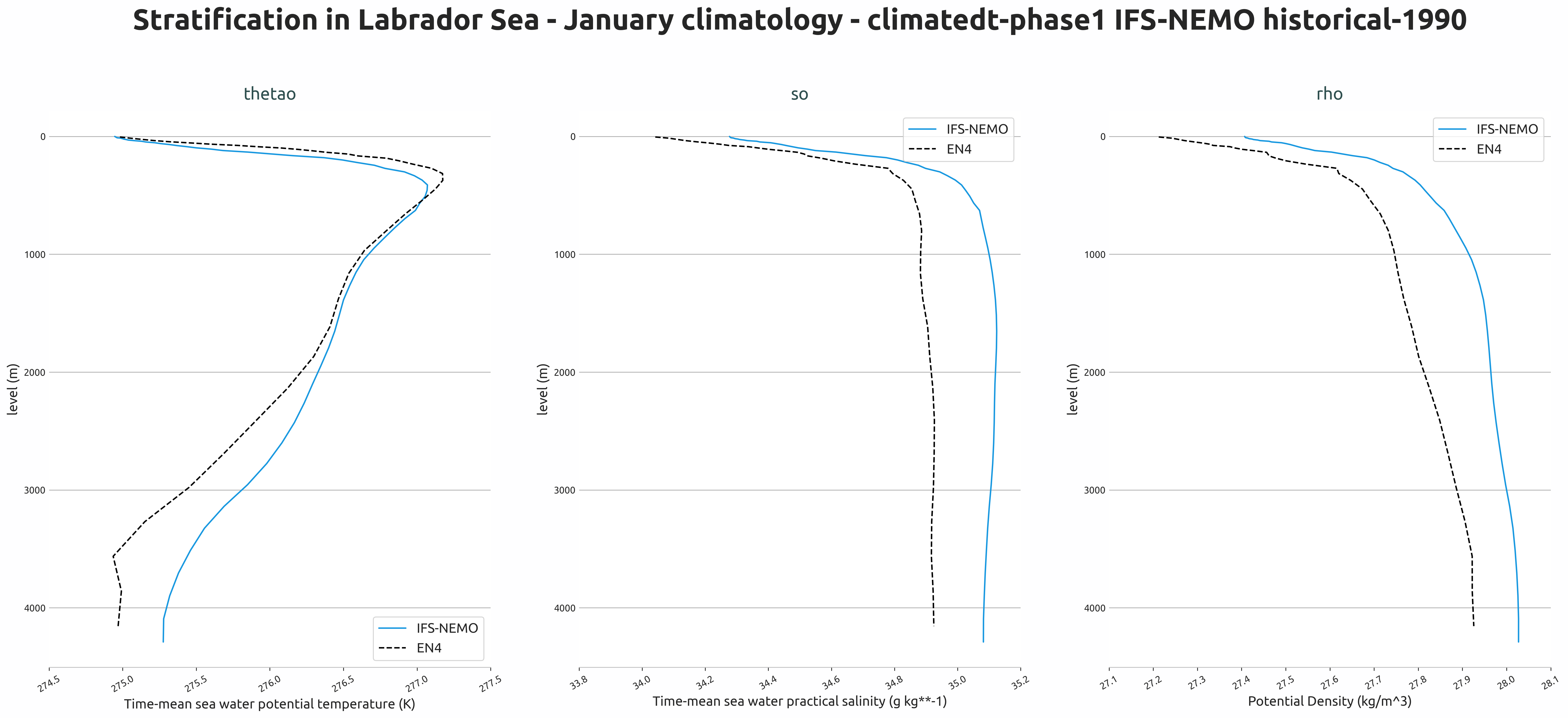
Vertical stratification profiles of temperature, salinity, and density in the Labrador Sea (January climatology) from IFS-NEMO historical-1990 experiment compared to EN4 observations.
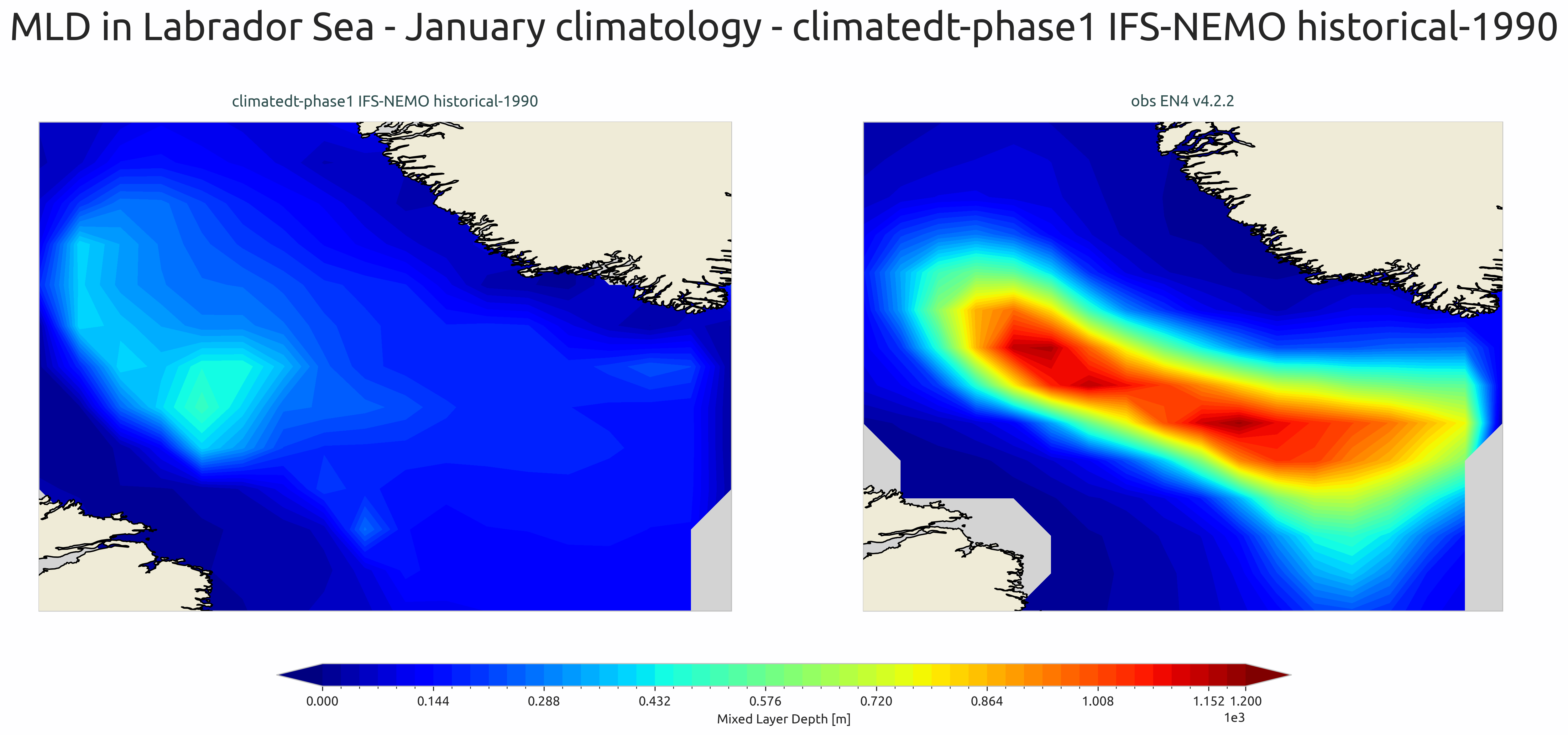
Mixed layer depth spatial distribution for January climatology in the Labrador Sea from IFS-NEMO historical-1990 experiment compared to EN4 observations.
Available demo notebooks
Notebooks are stored in notebooks/diagnostics/ocean_stratification:
Detailed API
This section provides a detailed reference for the Application Programming Interface (API) of the “ocean3d” diagnostic, produced from the diagnostic function docstrings.
- class aqua.diagnostics.ocean_stratification.PlotMLD(data: Dataset, obs: Dataset = None, diagnostic_name: str = 'ocean_stratification', outputdir: str = '.', loglevel: str = 'WARNING')
Bases:
objectClass for plotting Mixed Layer Depth (MLD) maps.
Class to plot Mixed Layer Depth (MLD) maps.
- Parameters:
data (xr.Dataset) – Dataset containing the MLD data to be plotted.
obs (xr.Dataset, optional) – Dataset containing observational MLD data for comparison. Default is None.
clim_time (str, optional) – Climatological time period for the data. Default is “January”.
diagnostic_name (str, optional) – Name of the diagnostic. Default is “ocean_stratification”.
outputdir (str, optional) – Directory to save the output plots. Default is the current directory.
loglevel (str, optional) – Logging level. Default is “WARNING”.
- plot_mld(rebuild: bool = True, region: str = None, proj_name: str = 'PlateCarree', extent: list = None, save_format: str | list = ['png', 'pdf', 'svg'], dpi: int = 300)
Generate and save the MLD map plot.
- Parameters:
rebuild (bool, optional) – If True, rebuild existing output files. Default is True.
region (str, optional) – Region name to override the dataset’s default. Default is None.
proj_name (str, optional) – Cartopy projection name. Default is “PlateCarree”.
extent (list, optional) – Map extent as [lonmin, lonmax, latmin, latmax]. Default is None.
save_format (str or list, optional) – Format(s) to save the figure. Default is SAVE_FORMAT.
dpi (int, optional) – Resolution of the saved figure. Default is 300.
- save_plot(fig, diagnostic_product: str = None, extra_keys: dict = None, rebuild: bool = True, dpi: int = 300, format: str = ['png', 'pdf', 'svg'], metadata: dict = None)
Save the plot to a file.
- Parameters:
fig (matplotlib.figure.Figure) – The figure to be saved.
diagnostic_product (str) – The name of the diagnostic product. Default is None.
extra_keys (dict) – Extra keys to be used for the filename (e.g. season). Default is None.
rebuild (bool) – If True, the output files will be rebuilt. Default is True.
dpi (int) – The dpi of the figure. Default is 300.
format (str or list) – Format(s) to save the figure. Default is SAVE_FORMAT.
metadata (dict) – The metadata to be used for the figure. Default is None. They will be complemented with the metadata from the outputsaver. We usually want to add here the description of the figure.
- set_cbar_labels(var: str = None)
Set the colorbar label for the given variable.
- Parameters:
var (str, optional) – Variable name to derive the colorbar label from.
- set_cbar_limits()
Set the colorbar limits and number of levels for MLD plots.
- set_central_lat_lon()
Set the central latitude and longitude for the map projection.
- set_convert_lon(data=None)
Convert longitude from 0-360 to -180 to 180 and sort accordingly.
- set_data_map_list()
Build the list of DataArrays to be plotted as maps.
- set_description()
Build the figure description string including model and observation date ranges.
- set_extent()
Set the map extent based on the data’s coordinate range and region.
- set_figsize()
Set the figure size based on the number of rows and columns.
- set_nrowcol()
Set the number of rows and columns for the subplot grid.
- set_proj(proj_name: str = 'PlateCarree')
Set the Cartopy map projection.
- Parameters:
proj_name (str, optional) – Projection name (‘PlateCarree’ or ‘Orthographic’). Default is ‘PlateCarree’.
- set_suptitle(plot_type=None)
Set the title for the MLD plot.
- set_title()
Set the title for each subplot panel.
- set_ytext()
Set the y-axis text labels for each subplot.
- class aqua.diagnostics.ocean_stratification.PlotStratification(data: Dataset, obs: Dataset = None, diagnostic_name: str = 'ocean_stratification', vert_coord: str = 'depth', outputdir: str = '.', loglevel: str = 'WARNING')
Bases:
objectClass for plotting ocean stratification vertical profiles.
Initialize PlotStratification with model and observational datasets.
- Parameters:
data (xr.Dataset) – Dataset containing stratification variables to plot.
obs (xr.Dataset, optional) – Observational dataset for comparison. Default is None.
diagnostic_name (str, optional) – Name of the diagnostic. Default is “ocean_stratification”.
vert_coord (str, optional) – Vertical coordinate name. Default is DEFAULT_OCEAN_VERT_COORD.
outputdir (str, optional) – Directory to save output plots. Default is “.”.
loglevel (str, optional) – Logging level. Default is “WARNING”.
- plot_stratification(rebuild: bool = True, save_format: str | list = ['png', 'pdf', 'svg'], dpi: int = 300)
Generate and save the stratification vertical profile plot.
- Parameters:
rebuild (bool, optional) – If True, rebuild existing output files. Default is True.
save_format (str or list, optional) – Format(s) to save the figure. Default is SAVE_FORMAT.
dpi (int, optional) – Resolution of the saved figure. Default is 300.
- save_plot(fig, diagnostic_product: str = None, extra_keys: dict = None, rebuild: bool = True, metadata: dict = None, dpi: int = 300, format: str | list = ['png', 'pdf', 'svg'])
Save the plot to a file.
- Parameters:
fig (matplotlib.figure.Figure) – The figure to be saved.
diagnostic_product (str) – The name of the diagnostic product. Default is None.
extra_keys (dict) – Extra keys to be used for the filename (e.g. season). Default is None.
rebuild (bool) – If True, the output files will be rebuilt. Default is True.
dpi (int) – The dpi of the figure. Default is 300.
format (str or list) – Format(s) to save the figure. Default is SAVE_FORMAT.
metadata (dict) – The metadata to be used for the figure. Default is None. They will be complemented with the metadata from the outputsaver. We usually want to add here the description of the figure.
- set_cbar_labels(var: str = None)
Set the colorbar label for the given variable.
- Parameters:
var (str, optional) – Variable name to derive the colorbar label from.
- set_cbar_limits()
Set the colorbar limits and number of levels for MLD plots.
- set_data_list()
Populate the data and reference data lists for plotting.
- set_description()
Build the figure description string including model and observation date ranges.
- set_label_line_plot()
Set the legend labels for the model and observation lines.
- set_nrowcol()
Set the number of rows and columns for the subplot grid.
- set_suptitle()
Set the title for the MLD plot.
- set_title()
Set the title for each subplot panel.
- set_ytext()
Set the y-axis text labels for each subplot.
- class aqua.diagnostics.ocean_stratification.Stratification(catalog: str = None, model: str = None, exp: str = None, source: str = None, regrid: str = None, startdate: str = None, enddate: str = None, diagnostic_name: str = 'stratification', vert_coord: str = 'depth', loglevel: str = 'WARNING')
Bases:
DiagnosticDiagnostic class for analyzing ocean stratification.
Parameters
- catalogstr, optional
Path to the data catalog (e.g., intake-esm catalog).
- modelstr, optional
Name of the climate model to analyze.
- expstr, optional
Experiment name (e.g., ‘historical’, ‘ssp585’).
- sourcestr, optional
Data source (e.g., ‘CMIP6’, ‘OBS’).
- regridstr, optional
Regridding method or target grid (e.g., ‘1x1’, ‘nearest’).
- startdatestr, optional
Start date of the analysis period (format: ‘YYYY-MM-DD’).
- enddatestr, optional
End date of the analysis period (format: ‘YYYY-MM-DD’).
- loglevelstr, optional
Logging level (default is “WARNING”).
Attributes
- loggerlogging.Logger
Configured logger for the diagnostic.
Initialize the Stratification diagnostic.
Parameters
- catalogstr, optional
Path to the data catalog.
- modelstr, optional
Name of the climate model to analyze.
- expstr, optional
Experiment name.
- sourcestr, optional
Data source identifier.
- regridstr, optional
Regridding method or target grid.
- startdatestr, optional
Start date of the analysis period (format: ‘YYYY-MM-DD’).
- enddatestr, optional
End date of the analysis period (format: ‘YYYY-MM-DD’).
- diagnostic_namestr, optional
Name of the diagnostic (default: “stratification”).
- vert_coordstr, optional
Vertical coordinate name (default: DEFAULT_OCEAN_VERT_COORD).
- loglevelstr, optional
Logging level (default: “WARNING”).
- MINIMUM_MONTHS_REQUIRED = 12
- calculate_rho()
Convert variables to absolute salinity and conservative temperature, then compute potential density.
Updates the internal dataset with the computed potential density anomaly (‘rho’).
Returns
None
- compute_climatology(climatology: str = 'season')
Compute climatology for the dataset based on the specified period type.
Depending on the value of self.climatology, the method will: - Group and average the data along the corresponding time accessor if self.climatology is not one of [“month”, “year”, “season”]. - Compute the overall mean across the time dimension if self.climatology is “total”.
Parameters
- climatologystr, optional
Type of climatology to compute. Expected values: - “month” : Monthly climatology - “year” : Yearly climatology - “season” : Seasonal climatology - “total” : Mean over all available time steps - Other : Groups data by time.<self.climatology> and averages Default is “season”.
Returns
None
- compute_mld()
Compute the mixed layer depth (MLD) from the density field.
Uses the potential density anomaly (‘rho’) in the dataset to compute MLD and adds it as ‘mld’.
Returns
None
- compute_stratification()
Compute the stratification by calculating climatology and density.
This method first computes the climatology (default: seasonal) and then computes the potential density. Updates the internal dataset with the results.
Returns
None
- run(outputdir: str = '.', rebuild: bool = True, region: str = None, var: list = ['thetao', 'so'], dim_mean=None, climatology: str = 'month', reader_kwargs: dict = {}, mld: bool = False)
Run the stratification diagnostic workflow.
This method orchestrates the complete diagnostic process: 1. Reads the required variables from the input source. 2. Optionally selects a specified region. 3. Optionally computes mean values over given dimensions. 4. Computes stratification by generating climatology and potential density. 5. Optionally computes mixed layer depth (MLD). 6. Saves the processed dataset to a NetCDF file.
Parameters
- outputdirstr, optional
Directory where the output NetCDF file will be saved. Default is the current directory (” . “).
- rebuildbool, optional
If True, overwrite the existing output file. Default is True.
- regionstr, optional
Name of the region to select for analysis. If None, no region selection is applied.
- varlist of str, optional
Names of variables to retrieve. Default is [“thetao”, “so”].
- dim_meanlist of str or str, optional
Dimensions over which to average the data. If None, no averaging is applied.
- climatologystr, optional
Type of climatology to compute (“month”, “year”, “season”, “total”). Default is “month”.
- reader_kwargsdict, optional
Additional keyword arguments passed to the data reader.
- mldbool, optional
If True, compute mixed layer depth (MLD) and include it in the output.
Returns
None
- save_netcdf(data, diagnostic: str = 'ocean_circulation', diagnostic_product: str = 'stratification', region: str = None, outputdir: str = '.', rebuild: bool = True)
Save the diagnostic output to a NetCDF file.
Parameters
- dataxarray.Dataset or xarray.DataArray
The dataset or data array to save.
- diagnosticstr, optional
High-level diagnostic category (default is “ocean_circulation”).
- diagnostic_productstr, optional
Specific diagnostic product name (default is “stratification”).
- regionstr, optional
Region name to include in metadata or filename.
- outputdirstr, optional
Directory where the NetCDF file will be saved (default is current directory).
- rebuildbool, optional
If True, force rebuild of NetCDF file even if it exists (default is True).